
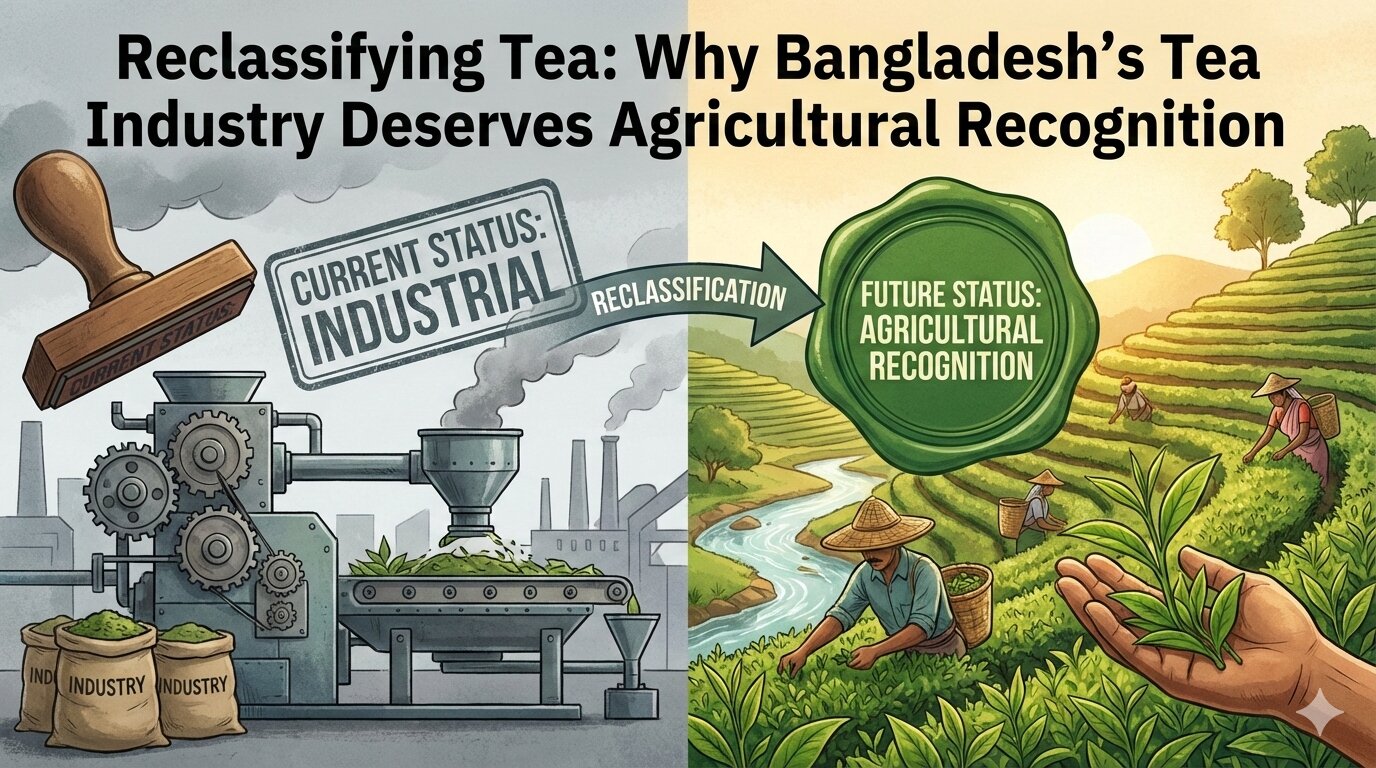
Tea is not just limited to a beverage—it’s connected with people’s emotions, a livelihood, and on top of that leaf that connects Bangladesh’s hills to the global market industry. The rotary green mountain of Sylhet, Moulvibazar, Habiganj, and Chattogram don’t just limit to producing tea — they nurture living, traditions, and a booming rural economy. Yet despite all of this, tea in Bangladesh is not officially categorized as an agricultural crop. This technicality may seem less significant, but it has notable implications, particularly when the matter comes to loans, subsidies, and policy support.
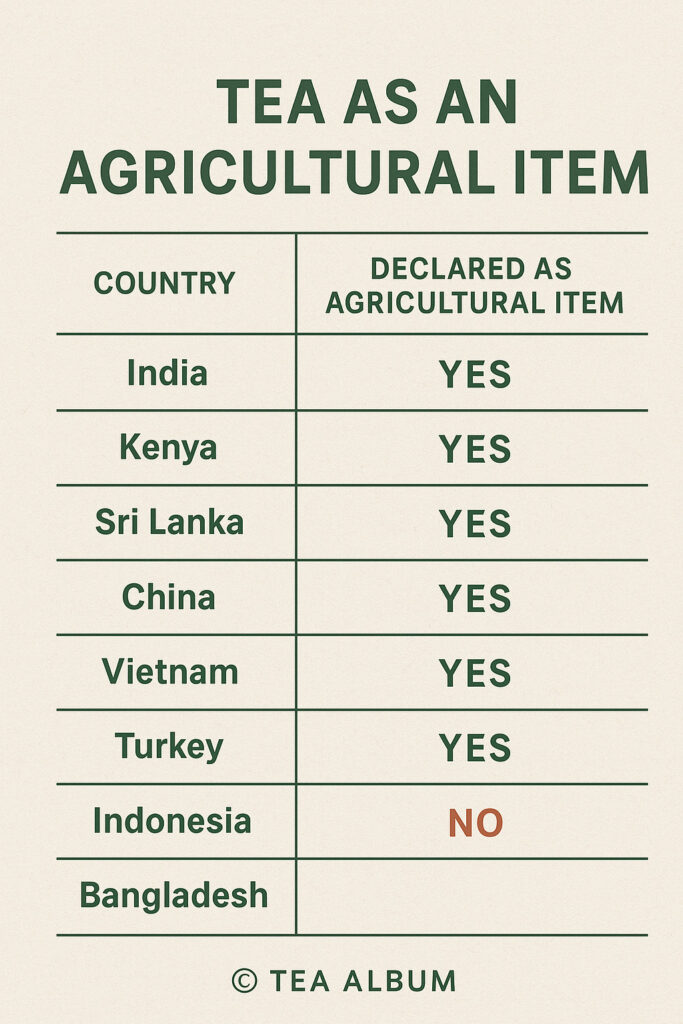
Let’s take a look at why the tea sector should be officially acknowledged as part of the agricultural sector — and what’s at stake if it’s not. From the list in the below it is quite evident that among the top 10 tea producing nation only Bangladesh and Indonesia do not have agricultural status. Which itself clarify the gravity of the issue.
🌿 Tea Is Grown Like Any Other Crop
Like rice, jute, or sugarcane, tea is a perennial crop that depends on soil, rainfall, and sunlight. It is harvested from the wonder tree Camellia sinensis.
Its life cycle is mostly reliant on traditional agricultural labour:
- Young bushes are planted and pruned.
- Hand-picking tea leaves, usually by female employees
- Using irrigation and fertilisers
- Protecting plants from diseases and pests
In summary, tea is an agricultural product before it goes through the processing stage.
👩🌾 A Rural Backbone
The tea industry directly provides the bread and butter for about 4-5 lakh members of marginalised and rural communities. From field maintenance to leaf harvesting, the majority of their daily activities are related to agriculture.
These underprivileged workers and smallholders will benefit from safety nets, training programs, and welfare initiatives connected to agriculture if tea is classified as an agricultural item.
💸 The Hidden Cost of Misclassification: Loan Barriers
One of the major drawbacks of not being categorised as agricultural is restricted access to agricultural loans.
Higher Interest Rates:
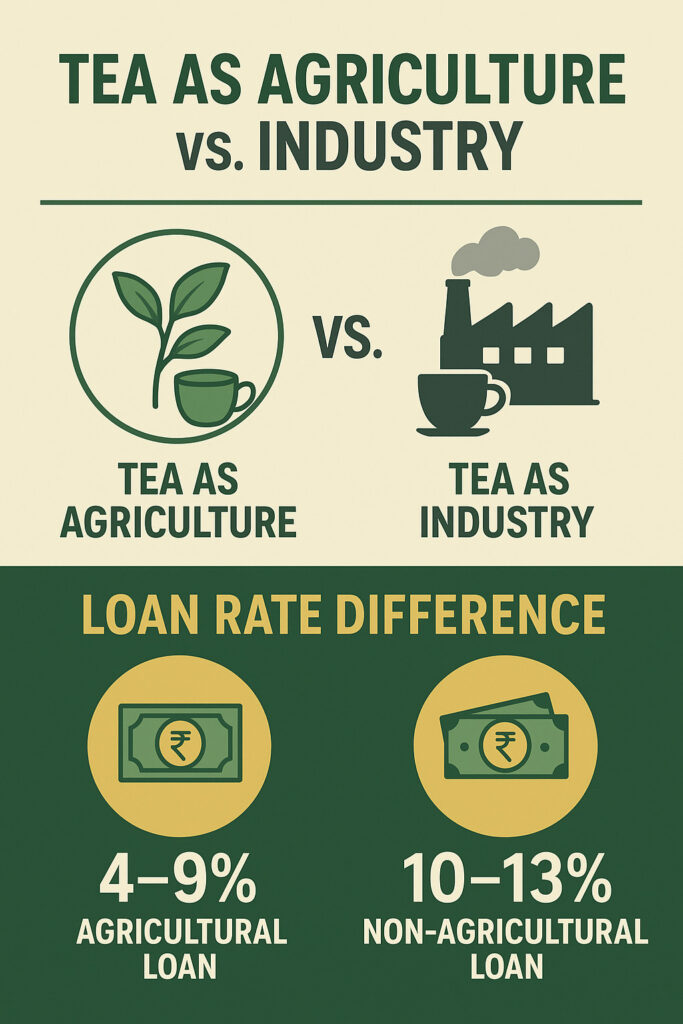
Generally, agricultural loans in Bangladesh often come with lower interest rates, ranging from 4% to 9%; on the other hand, non-agricultural or industrial loans can exceed the margins of 10–13%.
Limited Access to Credit:
Institutions like Banks and microfinance generally have devoted agricultural lending quotas. Because tea in Bangladesh is not treated as an agricultural product, many tea gardens do not qualify.
🌏 Global Context
In leading tea-producing countries, such as India, Sri Lanka, Kenya, and China, tea is officially recognized as a vital part of the agricultural economy. This itself is a great advantage for the industry in many ways.
For example, this allows their growers to be eligible for the government subsidies, weather insurance, and low-interest credit. In addition, for Bangladesh to take part in global competition, it’s super important to align with these international practices.
🧩 Policy Benefits of Recognising Tea as Agriculture
By reclassifying tea under the agricultural sector, Bangladesh could potentially unlock several opportunities that could have a positive impact on the tea industry:
- Inclusion in national agricultural development policies
- Eligible for the agriculture-based credit and insurance schemes
- Boost research and broad support through BTRI and the Department of Agriculture
- Excellent rural livelihood programs for tea workers
- Better data alignment with global tea statistics
💰 Financial and Economic Benefits
Access to Low-Interest Loans:
The most notable benefit of the tea industry is its opportunity to access low-interest loans. While right now, the tea industry is borrowing at a very high interest rate. If there is no agricultural status, they have to borrow at commercial rates, which results in increases the cost of production.
- Investment and Modernization: Lower-interest loans will boost essential investments for:
- Replanting old, low-yielding tea bushes.
- Revamp tea factory by introducing modern machinery.
- Tea production is heavly rely on timely irrigation. Most of the gardens fail to do so bceuase of high cost. So why introducing better irrigation techniques will increase crop.
- Cost Management: acknowledge tea as an agricultural item would aid planters reduce the rising costs of inevitable ingridient like fertilizer, pesticides, gas, and electricity, allowing the business more sustainable.
👥 Social and Employment Contribution
Employment Generation: About 4 million people are directly or indirectly dependent on the tea industry, mostly in remote and underprivileged areas.
Socio-Economic Importance: Tea production remains one of the most important parts of the economy of Sylhet divisions and the northern plains of Panchagarh, playing an instrumental role in poverty mitigation. Moreover it is responsible for providing a social outlet for diverse communities.
About The Author

Leave feedback about this