


Tea has become the fan favorite beverage around the globe for a reason. While some like green tea, others like black tea. Both tea variants are different from each other, not only in terms of taste but also in production. Today, we will discuss the key differences between these two types of tea.
Rapid Brainstorming
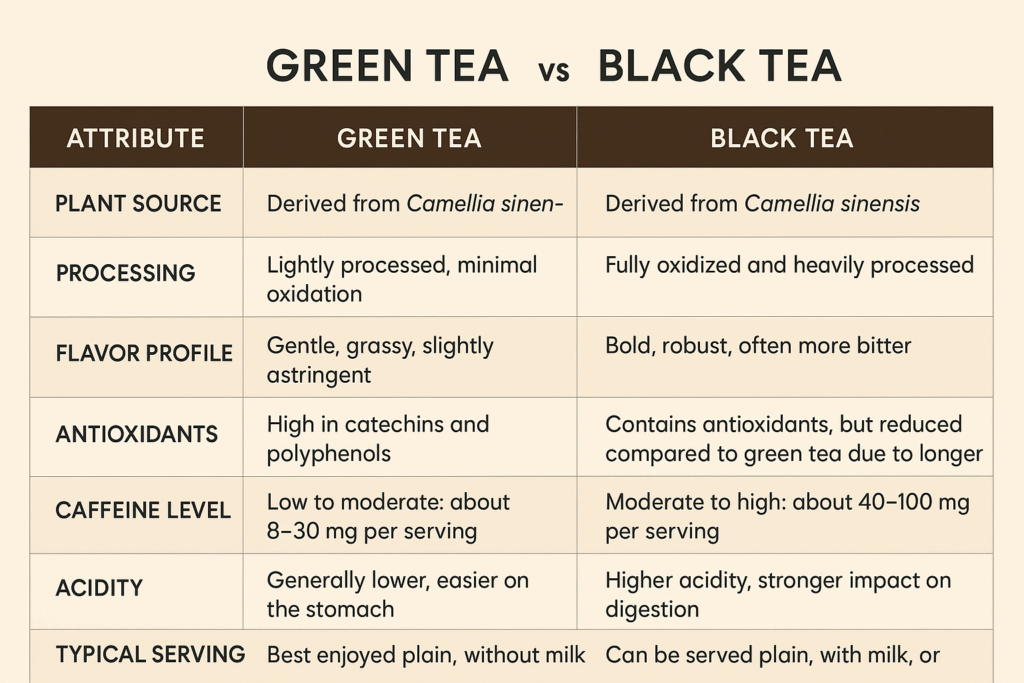
Before diving deep into the topic, it’s super important to know that both teas are made from the same kind of ingredient, and it’s Camellia sinensis. The core difference is how the leaves are maintained after plucking. In addition, we can easily differentiate bo
It requires full oxidation when it comes to black tea; on the other hand, green tea can be prepared with a minimum amount of oxidation. Black tea produces darker in color leaves, while green tea becomes grassy in flavour.

Which types of tea you like most?
Green Tea vs Black Tea Key Attributes Comparison:
How processing creates the difference
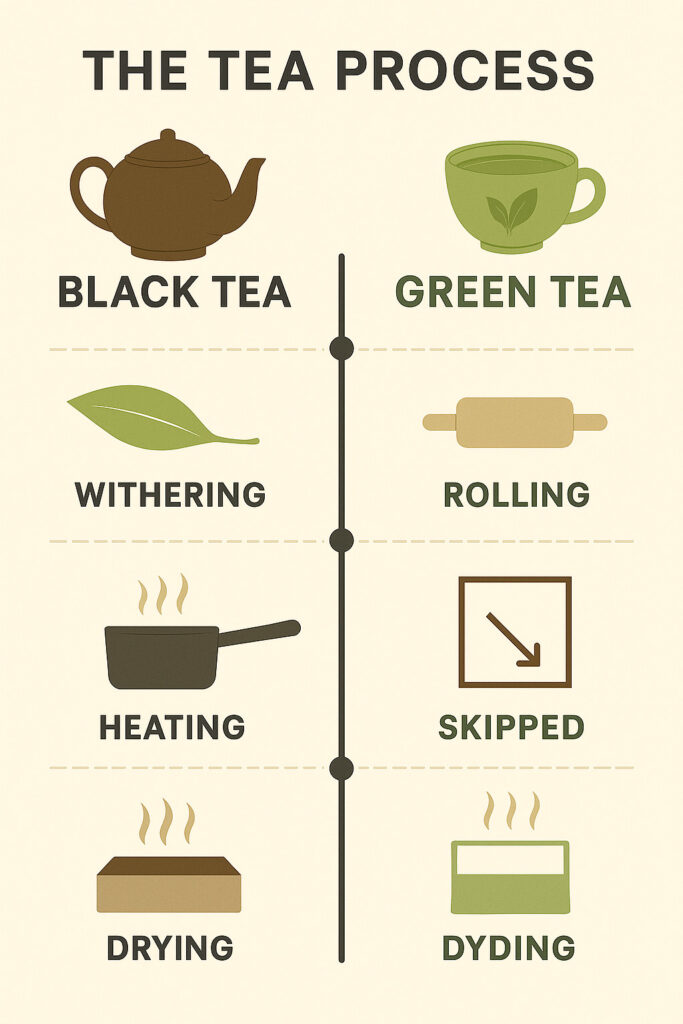
We can easily differentiate two popular types of tea with the level of oxidation. Right away, the tea is being plucked. While the core difference is how the leaves are being maintained after plucking.
Green tea
- Withering (short period or skipped) → Heating (pan-firing or steaming) to hinder oxidation quickly → Rolling/shaping → Drying
- Heating inactivates the enzymes that cause oxidation, so polyphenols remain in their native form (catechins).
- Outcome: green or yellow-green leaves, delicate/herbal/vegetal flavors.
Black tea
- Withering to minimize moisture to prepare the leaves for a even break in ctc → Bruising/rolling to break cells and expose enzymes → Full oxidation (enzymes convert catechins into theaflavins and thearubigins) → Firing/drying
- Outcome: dark brown to black leaves, malty/robust flavor and darker liquor.
Practical brewing & selection tips
- Green tea
- Need compartively lower water temperature (70–85°C / 160–185°F).
- Shorter steep (30 sec–2 min); multiple short infusions often yield good results.
- Keep in a cool, airproof container away from light and odors.
- Choose whole leaves or high-quality loose-leaf for better flavor; Japanese steamed greens (sencha, gyokuro) differ from Chinese pan-fired types (longjing).
- Black tea
- Brew near boiling (95–100°C / 203–212°F).
- Steep 3–5 minutes depending on strength desired.
- For nice expereince with milk/sugar/honey; strong blacks (Assam) hold milk well.
- CTC (crush-tear-curl) blacks are usually found in tea bags and milk teas; orthodox whole-leaf blacks can deliver complex flavors.
- General selection
- Look for recent harvest date (if labeled).
- Aroma and whole-leaf appearance indicate care in processing.
- Fair-trade / organic / sustainably certified options may be worth considering for environmental and social reasons.
Culinary & cultural notes
- Green tea: Mostly used in East Asian cuisine and ceremonies (matcha in Japanese tea ceremony, cooking, and sweets). Matcha is a exceptional types of green tea which has concentrated flavor and caffeine.
- Black tea: Preferred by British-style tea culture (Afternoon Tea), Indian chai (spiced milk tea), and also popular among people for consuming in breakfast time.
- Cooking: Black & Green tea can be use in broths, desserts, smoked or infused dishes — their divergent strengths and flavors produce them versatile culinary ingredients.
Level of Caffeine
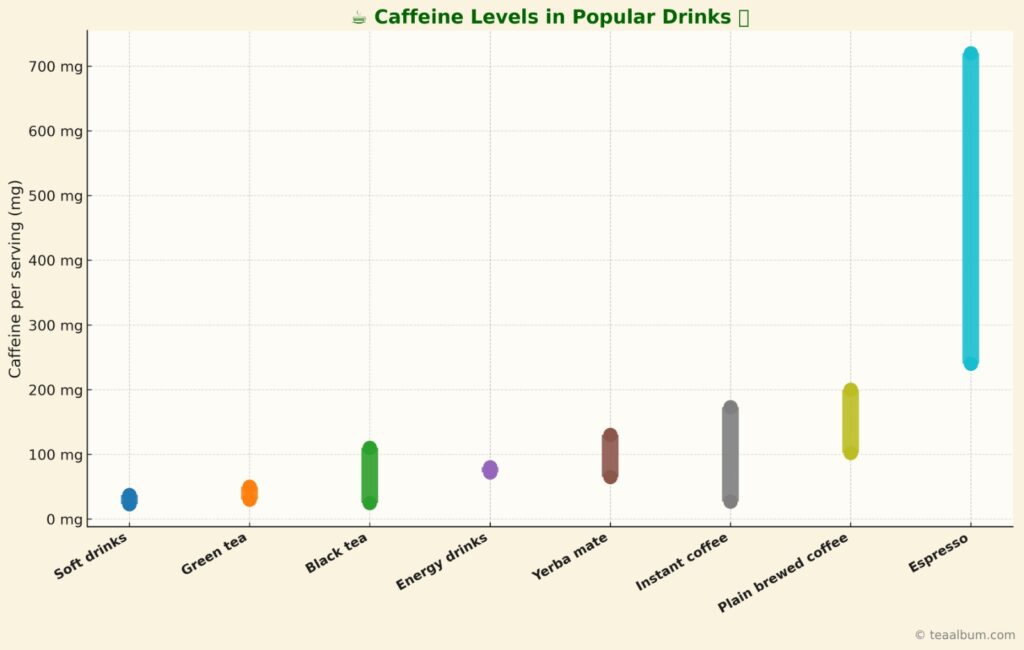
Green Tea: Traditionally consists fewer amount of caffeine than black tea, with an 8-ounce cup having around 30–50 mg.
Black Tea: On the other hand, Black tea has a rich caffeine profile, in an 8-ounce cup consisting about 40–70 mg. While, the levels of caffeine for both type of teas can be influence by timing of brew and temperature.
In the below we have compared different types of drink alongside black & green tea to get an idea where they stands in crowd.

Final takeaways
Green and black tea do provide us distinct sensory experiences, in addition to some extend contrasting biochemical profiles driven by processing.
Both of them are healthy beverage choices in modern society and can be pick based on flavour preference, caffeine level, or certain ingredients of interest (catechins vs theaflavins). For maximum number of people, rotating varieties and enjoying tea in the way that fits their taste and lifestyle is the most practical approach.